


Inference cost controls are reliability controls
Inference cost controls are reliability controls
Assumption to challenge
Many leadership teams still treat inference spend as a finance optimization problem: cap tokens, negotiate model rates, and report monthly savings.
That framing is incomplete. When cost control is detached from runtime behavior, reliability degrades first and budget variance appears later. By the time finance sees red, customer trust has already taken the hit.
Why it breaks now
Three operating shifts make the old assumption risky.
First, agentic and retrieval-heavy workflows increase variance. The same user intent can trigger very different token paths based on prompt branching, tool calls, and retrieval quality. Cost spikes and latency spikes now occur in the same failure window.
Second, model portfolios are widening. Teams route across frontier, distilled, and domain-tuned models. Without explicit routing controls, fallback chains drift into expensive and slower paths precisely when demand is stressed, turning resilience events into spend events.
Third, executive accountability has moved up-stack. Boards increasingly ask for AI resilience outcomes, not just AI velocity. They want to know whether critical workflows degrade safely when budgets, quotas, or provider limits are breached. Cost-only reporting cannot answer that because it has no service-level consequence model.
Strategic reframe
Treat inference economics as a reliability control plane.
Thesis: inference cost controls should be designed as runtime reliability controls with explicit SLO intent.
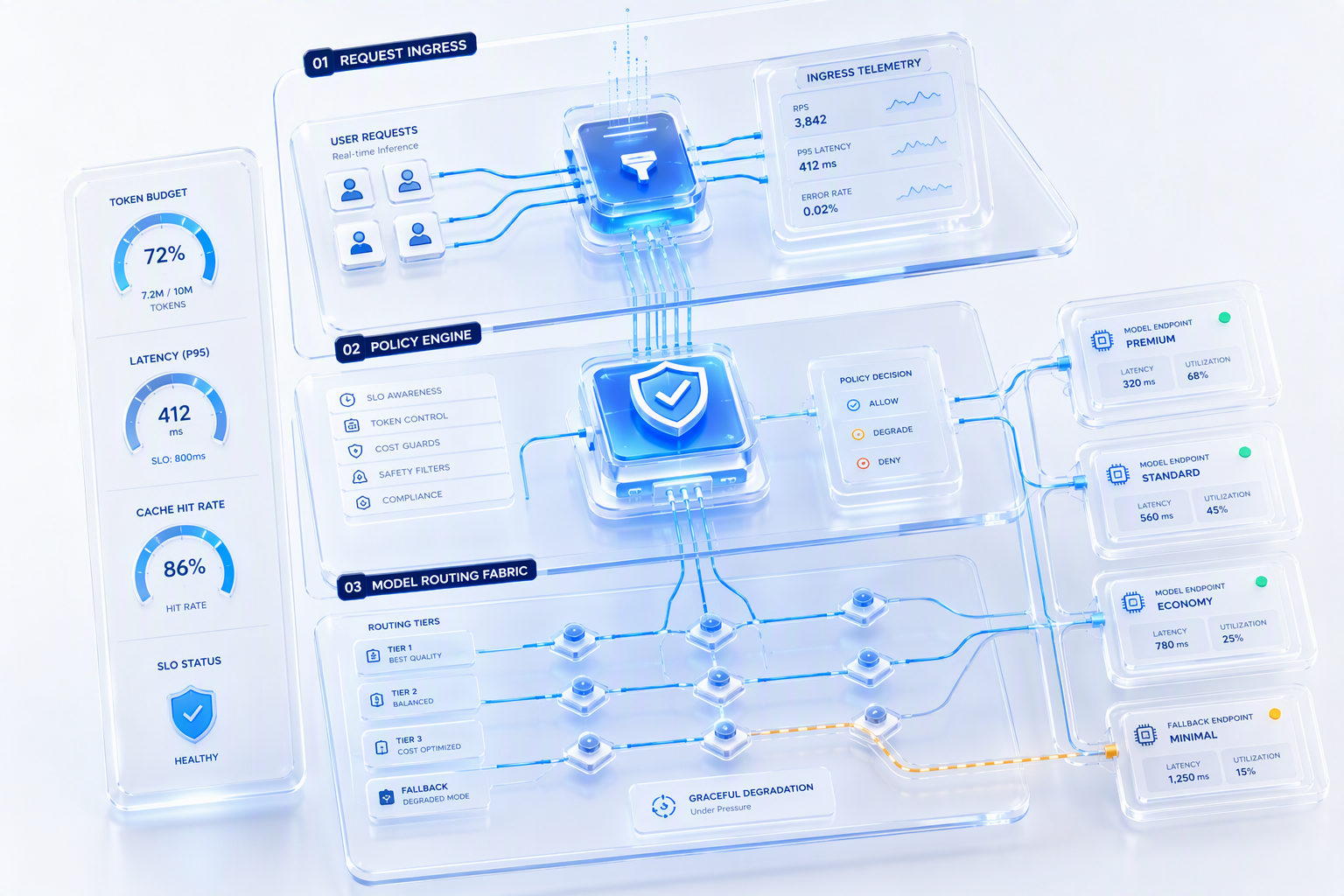
Token budgets are not only spend levers; they are workload-shaping controls. Routing policies are not only quality decisions; they are failure-domain boundaries. Cache hit targets are not only efficiency metrics; they are protections for latency and capacity. Degradation tiers are not admission of failure; they are pre-authorized reliability behavior.
The leadership question therefore shifts from "How do we reduce model spend?" to "How do we keep response quality and service objectives predictable under cost pressure?"
Decision choices and trade-offs
Leaders face two operating models.
Reactive cost governance keeps finance and runtime reliability separate. Finance reviews spend after the fact, engineering tunes prompts in isolation, and platform teams apply temporary throttles during incidents. The benefit is low upfront process overhead. The cost is unstable customer experience and recurring incident toil.
Policy-driven inference governance treats cost and reliability as one system. Platform teams define routing, caching, rate-limit, and degradation policies tied to SLO impact. Product teams design explicit degradation behavior. Finance, product, and engineering share one control taxonomy and escalation path.
The second path demands more design discipline up front, but it reduces correlated failures: spend runaways, latency blowouts, and emergency model switching under load.
The downside of inaction is straightforward: your most expensive inference days will become your least reliable service days.
Recommended stance and first executive move
Recommended stance: classify inference cost controls as formal reliability controls in your architecture governance model.
First executive move this week: mandate a cost-to-reliability control map for one tier-1 AI workflow. Require owners to define:
- routing tiers and fallback order,
- token and request thresholds mapped to SLO impact,
- cache strategy with target hit-rate bands,
- degradation behavior by threshold breach,
- shared escalation triggers across platform, product, and finance.
Do not begin with enterprise-wide standardization. Prove the model on one high-impact workflow, then scale after you have one month of control evidence.
Brewed insight
If inference controls only protect margin, they eventually damage uptime. If they are engineered as reliability controls, they protect margin and uptime together.
Sources
- Google Cloud Architecture Framework: Reliability — https://cloud.google.com/architecture/framework/reliability
- Microsoft Azure Well-Architected Framework: Reliability — https://learn.microsoft.com/azure/well-architected/reliability/
- AWS Well-Architected Framework: Reliability Pillar — https://docs.aws.amazon.com/wellarchitected/latest/reliability-pillar/welcome.html