


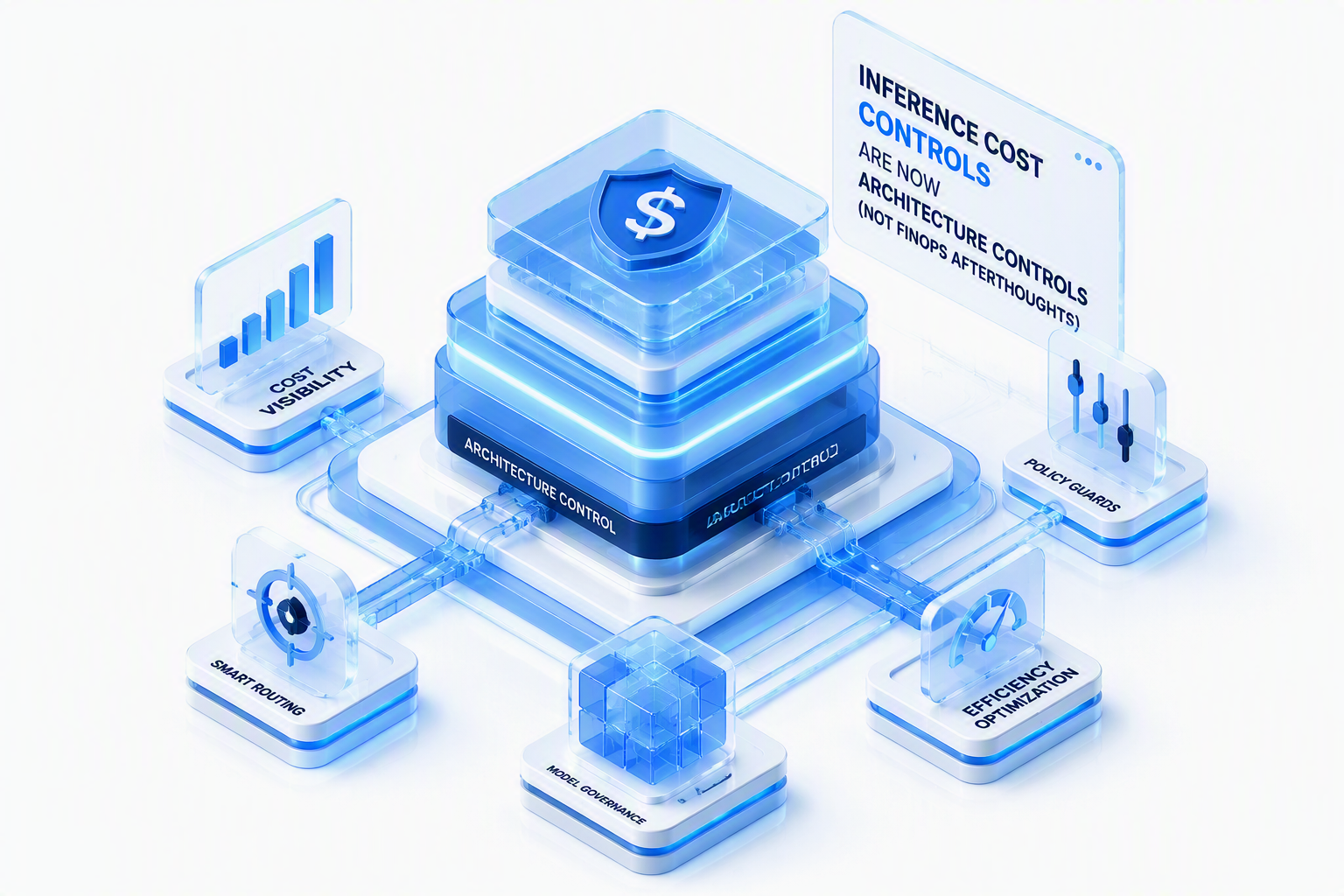
Inference Cost Controls Are Now Architecture Controls (Not FinOps Afterthoughts)
Inference Cost Controls Are Now Architecture Controls (Not FinOps Afterthoughts)
Assumption to Challenge
Most executive teams still treat inference cost as a monthly FinOps variance problem: optimize model rates, cap token usage, and report savings after the fact.
That assumption no longer holds. In production AI systems, cost behavior and service behavior are now coupled. When inference controls are weak, customer-facing reliability degrades first and budget instability follows.
Why It Breaks Now
Three operating shifts have changed the decision context.
First, agentic workflows amplify runtime variance. The same user intent can trigger very different token paths depending on retrieval quality, tool branching, and retry behavior. Cost spikes and latency spikes now appear in the same failure window.
Second, multi-model routing has become normal practice. Teams increasingly mix premium, distilled, and specialized models. Without explicit routing governance, fallback chains drift toward expensive and slower paths exactly when demand is stressed.
Third, accountability expectations have moved up the stack. Boards and executive committees are asking for control evidence: how systems degrade under pressure, who owns thresholds, and what decisions are pre-authorized when limits are breached. Cost dashboards alone cannot answer that.
Strategic Reframe
Inference economics should be governed as architecture control, not finance clean-up.
Thesis: token budgets, routing policy, caching strategy, and degradation tiers are a single control plane that should be designed against reliability objectives and business risk tolerance.
This reframe changes the leadership question from "How do we spend less on models?" to "How do we preserve service intent, customer trust, and margin when demand or model behavior shifts?"
A cloud-agnostic architecture view makes this practical. Every major platform now exposes similar control primitives: admission thresholds, routing policies, cache controls, and observability hooks. The differentiator is not tooling availability; it is control ownership and decision discipline.
Decision Choices and Trade-offs
Leaders are choosing between two operating models.
Model A: Reactive FinOps containment. Finance detects variance, engineering reacts with prompt or quota changes, and platform teams apply temporary runtime throttles. Benefit: low upfront governance overhead. Cost: repeated incident toil, unpredictable user experience, and slow root-cause closure.
Model B: Architecture-led control governance. Platform, product, and FinOps define a shared policy model that links routing, threshold bands, cache intent, and degradation actions to service-level outcomes. Benefit: fewer correlated failures and faster, safer decision-making during stress events. Cost: greater up-front design effort and stricter ownership boundaries.
The core trade-off is speed of local experimentation versus consistency of enterprise control evidence. Organizations that optimize only for local speed usually discover the penalty during high-demand events, when expensive model paths and degraded service quality arrive together.
Recommended Stance and First Executive Move
Recommended stance: classify inference cost controls as formal architecture controls governed jointly by platform engineering, product ownership, and FinOps leadership.
First executive move this week: mandate a cost-to-reliability control map for one tier-1 AI workflow and assign one accountable owner.
That map must define:
- routing tiers and fallback sequence by business criticality,
- threshold bands with explicit service-level consequence,
- cache strategy and target ranges for stability,
- degradation behavior for each threshold breach,
- escalation triggers with named cross-functional owners.
Run the map for 30 days and evaluate decisions using control evidence, not retrospective spend commentary.
Brewed Insight
When inference controls are treated as a finance afterthought, resilience is negotiated during incidents. When they are treated as architecture controls, resilience is pre-decided and margin protection becomes a byproduct of disciplined design.
Sources
- FinOps Foundation Framework — Capabilities: https://www.finops.org/framework/capabilities/
- NIST AI Risk Management Framework (AI RMF 1.0): https://www.nist.gov/itl/ai-risk-management-framework
- Google Cloud Architecture Framework — Reliability: https://cloud.google.com/architecture/framework/reliability
- AWS Well-Architected Framework — Reliability Pillar: https://docs.aws.amazon.com/wellarchitected/latest/reliability-pillar/welcome.html
- Azure Well-Architected Framework — Reliability: https://learn.microsoft.com/azure/well-architected/reliability/