


AI Agent Governance Is Becoming an Operating Model Decision
AI Agent Governance Is Becoming an Operating Model Decision
Assumption to Challenge
Most leadership teams still treat agent governance as a policy add-on. Build the agent, connect the tools, then ask security or platform to approve the edge cases. That sequence is backwards. By the time an agent can reach data and act on a workflow, the operating model has already made the important decisions.
Why It Breaks Now
The market signal is clear: vendors are no longer talking about agents as demos; they are shipping production primitives. Microsoft’s Zero Trust for AI guidance frames AI as a governed security boundary, not a novelty. AWS is now discussing persistent compute for production AI agents in Bedrock AgentCore. Those are not product footnotes. They are proof that the hard problem has moved from whether agents can act to who is allowed to let them act, under what evidence, and with what accountability.
That shift matters because agentic systems collapse old separations. A single workflow can cross knowledge retrieval, identity scope, approval chains, and downstream tools in one path. If governance is still bolted on after the fact, the business gets speed without control evidence and then discovers the gap only after the agent has already become part of production delivery.
Strategic Reframe
Agent governance is a control plane decision, not a policy memo.
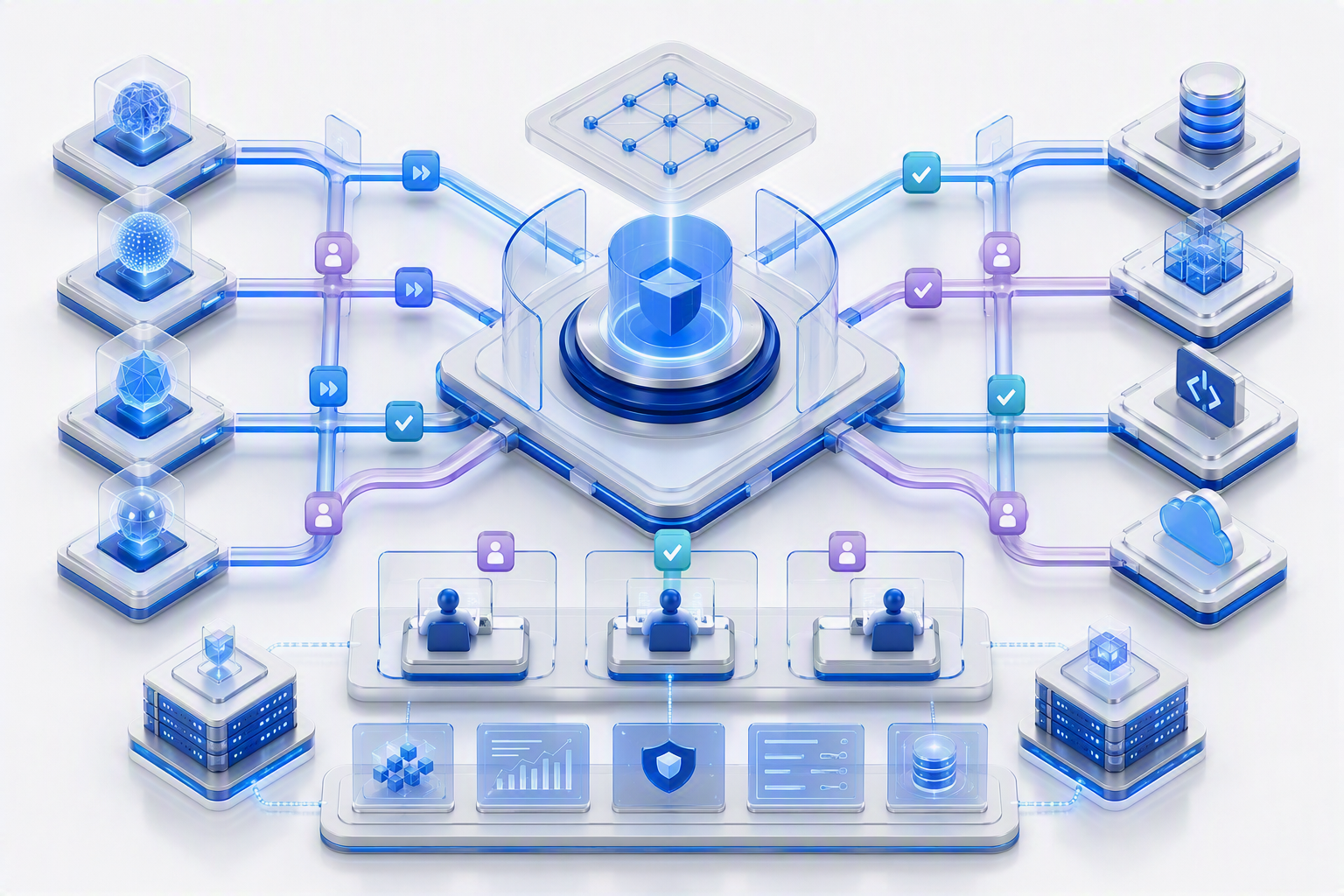
Thesis: an enterprise can scale AI agents only when autonomy tier, approval boundary, identity scope, logging standard, and accountable owner are designed together. If any one of those is left to local preference, the agent becomes an exception factory instead of a governed operating capability.
That is why the real question is not, "Can we deploy agents?" It is, "Who can authorise action, how is that authority bounded, and what evidence proves the boundary is still intact?" That is an operating model question with platform consequences, not a tooling question with a security review at the end.
Decision Choices and Trade-offs
There are two choices.
Speed-first autonomy lets each team wire agents into the workflow as fast as possible. The benefit is early adoption and less friction. The cost is fractured approval logic, inconsistent telemetry, and a wider blast radius once agents begin touching real systems.
Governed autonomy standardises the control plane first: one policy model, one audit standard, one escalation path, and clear ownership across platform, security, and the domain team. The benefit is evidence, repeatability, and safer scale. The cost is more up-front discipline and fewer shortcuts for local teams.
The trade-off is simple: speed of experimentation versus evidence of control. If leaders choose only speed, they do not remove governance work; they defer it until it becomes incident response.
Recommended Stance and First Executive Move
Treat agent governance as a shared platform-and-domain responsibility, with one autonomy model and one audit model across the first production workflows.
First executive move: pick one high-value agent workflow this week and define its control boundary end to end — autonomy level, approval point, credential scope, logging standard, and kill switch. Assign one accountable owner for that boundary and require explicit sign-off before the workflow scales to a second use case.
That move forces the organisation to decide where human approval lives, which evidence counts, and how much autonomy the business is actually willing to trust.
Brewed Insight
If governance arrives after the agent, the operating model is already leaking.
Sources
- Microsoft Security Blog - Advance Zero Trust for AI: New tools and guidance to secure AI agents and DevSecOps: https://www.microsoft.com/en-us/security/blog/2026/08/04/advance-zero-trust-for-ai-new-tools-and-guidance-to-secure-ai-agents-and-devsecops/
- Microsoft Security Blog - Better security starts with better questions: https://www.microsoft.com/en-us/security/blog/2026/07/29/better-security-starts-with-better-questions/
- AWS News Blog - Runtime instances: persistent compute for production AI agents on Amazon Bedrock AgentCore: https://aws.amazon.com/blogs/aws/runtime-instances-persistent-compute-for-production-ai-agents-on-amazon-bedrock-agentcore/