


Enterprise AI reliability is a resilience engineering problem
Enterprise AI reliability is a resilience engineering problem
Assumption to Challenge
The wrong assumption is that AI reliability is just model uptime. It is not. In production, the failure surface spans the model, retrieval, tools, prompts, identity, and the dependencies that connect them. If leaders only measure whether the model answers, they miss whether the system can fail safely.
Why It Breaks Now
The shift from experiments to production workflows changes the reliability contract. Microsoft’s Zero Trust guidance for AI agents shows that AI systems now sit inside security and operations boundaries, not outside them. AWS’s persistent runtime for production agents points to the same reality: these systems are no longer occasional prompts, they are always-on services. That makes resilience a design requirement, not a post-launch improvement.
This is where many teams fall into the trap of treating failures as rare exceptions. They assume the model will answer, the retriever will return, the tool will be available, and the workflow will complete. In practice, one weak dependency can turn a useful agent into a brittle one. The real issue is that no one has designed for graceful degradation.
Strategic Reframe
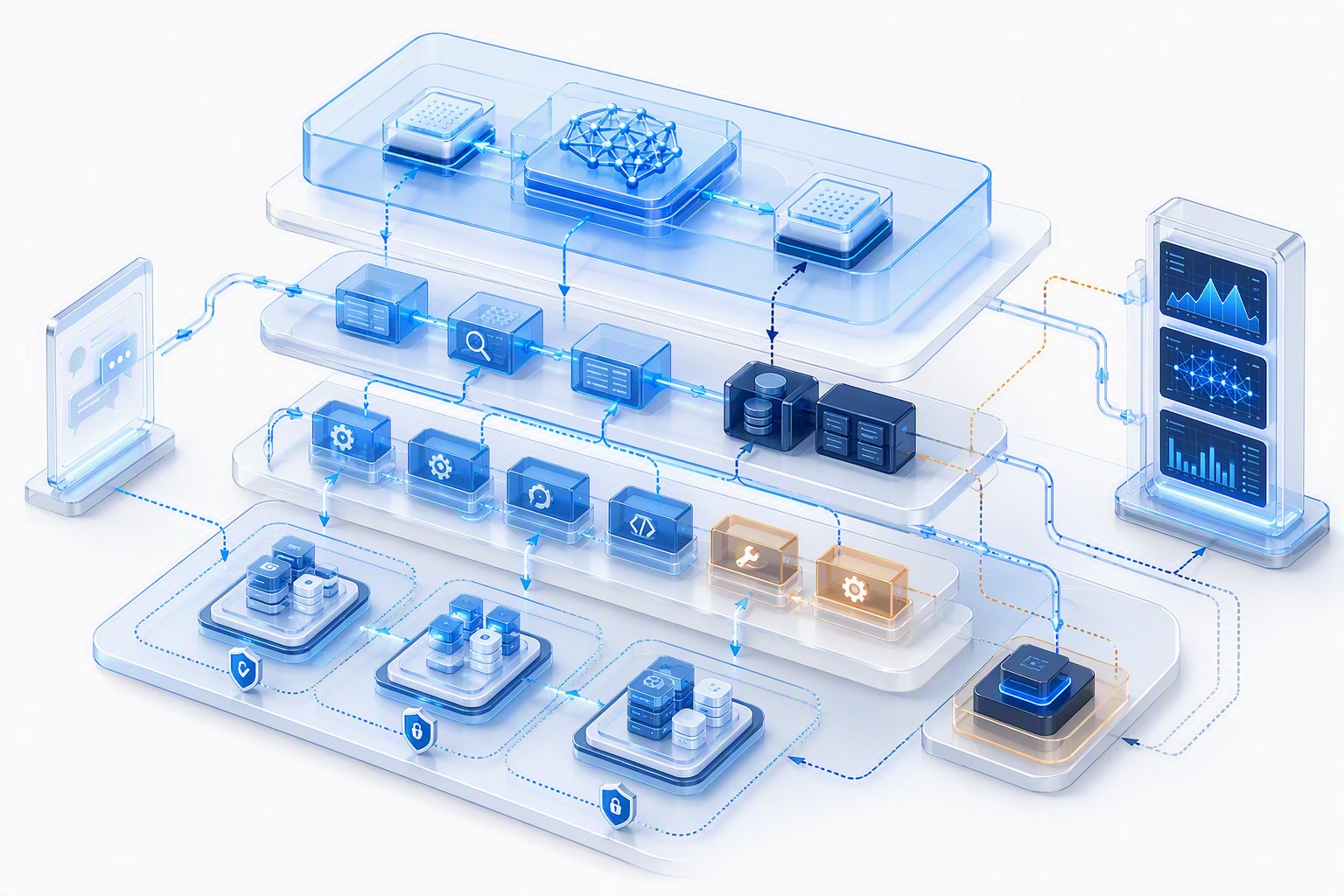
Treat AI reliability as resilience engineering for a compound system, not as model tuning. The architecture question is not “Is the answer correct on a good day?” It is “What happens when the model stalls, the retriever degrades, the tool fails, or the request must be rerouted under pressure?”
That requires three explicit design choices:
- failure modes for every critical dependency;
- fallback paths that preserve useful service instead of total outage;
- blast-radius limits so one bad path does not poison the whole workflow.
Decision Choices and Trade-offs
There are four trade-offs leaders need to make.
First, perfect answers versus dependable service. Chasing perfect responses can degrade availability; designing for dependable service usually means accepting a smaller, safer set of outcomes.
Second, single-path automation versus graceful degradation. A single fast path looks efficient until one dependency breaks. A degraded-mode design protects the user experience and the business workflow.
Third, richer dependencies versus isolation. More connected systems can do more work, but every added tool or retrieval path expands the reliability surface.
Fourth, optimism versus evidence. Teams often assume the system is resilient because it passed a pilot. Real evidence comes from observing failure behavior under load, not from the happy path.
Recommended Stance and First Executive Move
The right stance is resilience by design: every production AI workflow should have an explicit degraded mode, a bounded dependency set, and a named owner for each critical failure path.
The first executive move this week is simple: pick one production AI workflow and document what happens when the model, retriever, or tool layer fails. Define the fallback experience, the service boundary, and the owner who can approve a broader outage response. If that cannot be written down in one page, the workflow is not resilient enough for scale.
Brewed Insight
The most important reliability decision is not how well the AI works when everything is healthy; it is how safely it behaves when something is not.
Sources
- Microsoft Security Blog: Advance Zero Trust for AI: New tools and guidance to secure AI agents and DevSecOps — https://www.microsoft.com/en-us/security/blog/2026/08/04/advance-zero-trust-for-ai-new-tools-and-guidance-to-secure-ai-agents-and-devsecops/
- AWS News Blog: Runtime instances: persistent compute for production AI agents on Amazon Bedrock AgentCore — https://aws.amazon.com/blogs/aws/runtime-instances-persistent-compute-for-production-ai-agents-on-amazon-bedrock-agentcore/
- NIST AI Risk Management Framework — https://www.nist.gov/itl/ai-risk-management-framework