


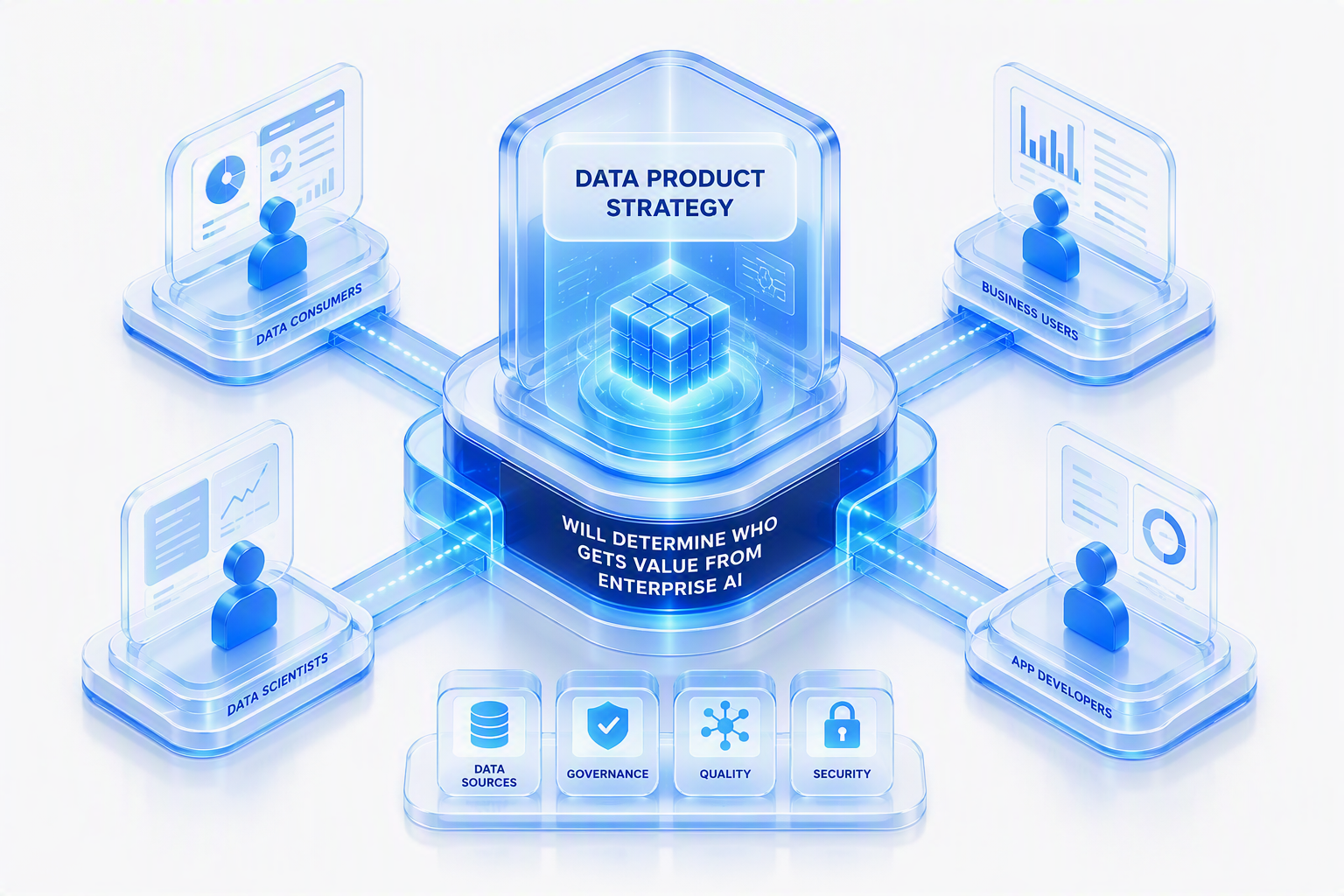
Data product strategy will determine who gets value from enterprise AI
Data product strategy will determine who gets value from enterprise AI
Assumption to Challenge
Many AI programmes still treat data as a central platform team's raw material: collect it, expose it through a lake or warehouse, and let use-case teams solve quality problems as they appear. That assumption makes data available without making it dependable or funded. A model can be upgraded centrally; an unreliable customer, finance, or operations data product still produces an unreliable decision.
Why It Breaks Now
AI is increasing the number of consumers and shortening the distance between a data defect and a business decision. Retrieval, forecasting, copilots, and automation all need freshness, lineage, definitions, and accountable remediation. When ownership is fragmented, the platform team is blamed for quality it cannot fix while domain teams support products they do not control.
The result is a hidden tax: repeated profiling, local copies, manual exceptions, and arguments over whether a result is trustworthy. The constraint is not data volume but the absence of a contract that says what the data means, how current it is, and who repairs it.
Strategic Reframe
Thesis: enterprise AI will scale only when strategically important domains are funded and managed as data products, with named owners who can promise what decisions their data is fit to support. Raw data volume and another enterprise standard do not create that accountability.
This is a portfolio and operating-model decision, not a cataloguing project. A data product needs a consumer promise: definition, freshness, quality, lineage, supported use, and a remediation clock. The platform provides standards, discovery, interoperability, and observability; domains own meaning and remediation. Funding should follow business-critical decisions, not every dataset. Trust becomes a maintained service with an economic owner, not a one-time certification.
Decision Choices and Trade-offs
Leaders can build a centrally managed enterprise data layer, or adopt federated domain data products on shared platform standards. Centralization simplifies definitions and operations, but creates a queue for domain changes and concentrates accountability in a team that may not own the source process. Federation preserves context and speeds remediation, but requires stronger contracts and cross-domain standards.
The choice is not centralization versus chaos. Federation still needs a paved road: naming, schemas, quality measures, lineage, access patterns, and escalation expectations. The sharper decision is which products deserve investment because they support material decisions. Funding everything equally produces a catalogue; funding the few products that unblock priorities produces leverage. Inaction leaves pilots unable to share trusted inputs or survive source changes.
Recommended Stance and First Executive Move
Recommended stance: use federated domain data products on shared platform standards, managed as a differentiated investment portfolio. Give each strategically important product a business owner, technical steward, freshness and quality SLA, source lineage, semantic contract, and remediation path. Treat a missed promise as an operating incident with funded remediation, not a consumer's integration problem.
First executive move this week: choose one material AI-enabled decision and identify its data product. Publish the contract: decision supported, owner, definition, freshness target, quality checks, lineage, consumers, and escalation clock. Review it for 30 days and fund recurring failure at source, not through another downstream workaround. If nobody owns the promise, the use case is not ready to scale.
Brewed Insight
AI programmes do not scale on the amount of data an enterprise stores. They scale on the number of strategically important data products whose owners are funded and able to keep a promise about a business decision.
Sources
- Microsoft Learn, "What is a data product?" https://learn.microsoft.com/fabric/real-time-intelligence/data-product
- Microsoft Learn, "Microsoft Purview data governance solutions" https://learn.microsoft.com/purview/data-governance-overview
- Data Mesh Principles and Logical Architecture, Zhamak Dehghani: https://martinfowler.com/articles/data-mesh-principles.html
- DAMA International, "Data Management Body of Knowledge": https://www.dama.org/cpages/body-of-knowledge