


AI Gateway Security Starts Before Inference
AI Gateway Security Starts Before Inference
Assumption to Challenge
Approving a package name and version, then protecting the model endpoint, can feel like a complete AI gateway security decision. It is not. A version label identifies what you asked to install; it does not, by itself, establish which source and release workflow produced the artifact or what authority the running process can reach.
The recent LiteLLM compromise used familiar software supply-chain techniques, not an AI-specific exploit. The strategic concern is what an AI gateway can concentrate: model-provider keys, database connections, workload identity, and gateway configuration.
Why It Breaks Now
Microsoft's October 23 analysis found that compromised LiteLLM 1.107.0 package files could execute during Python interpreter startup without the application importing LiteLLM. The maintainers' October 21 incident update reported that the compromised artifacts came from an attacker-controlled repository rather than the official source tag, while noting their investigation was ongoing. The incident demonstrates a gap between a trusted package label and the artifact actually executed.
The forensic report says the payload targeted credentials reachable to its process. That is not proof every credential was accessed or exfiltrated. Nor does one incident establish how common this failure is. It does show why endpoint policy cannot answer questions about build origin or process authority.
Strategic Reframe
Thesis: For consequential AI gateways, version allowlisting and model-endpoint controls are incomplete without a verified source-to-artifact policy enforced before installation and boundaries around the execution context's authority.
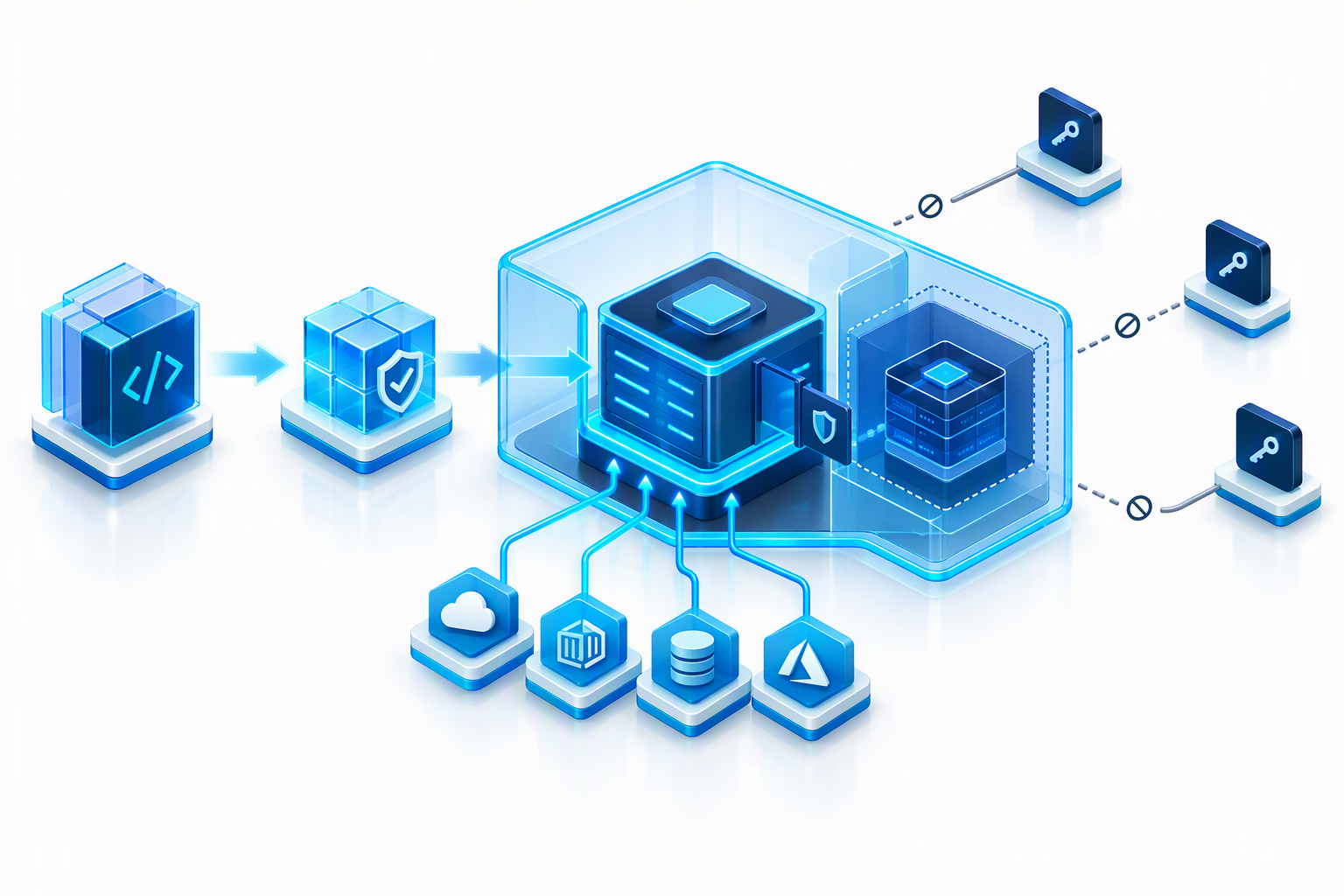
GitHub documents attestations that link artifacts to repositories, workflows, commits, and events. That provenance must be verified against an explicit policy. When an upstream package offers no verifiable provenance, an enterprise needs a trusted source build or curated registry path before it can enforce that policy. An attestation is not a safety certificate: it cannot rule out malicious code in an approved source or a compromised authorized signer. A useful gate can reject an artifact outside the approved release path; it cannot certify that every approved artifact is benign.
Decision Choices and Trade-offs
Version-only approval is fast and easy to operate, but cannot distinguish two artifacts with the same expected label if their origins differ. Provenance checks at a CI verification or registry-promotion gate add evidence before installation, but require policy ownership, maintenance, and release discipline. Digest pinning identifies expected bytes; provenance links those bytes to an origin. Egress controls constrain reachable destinations, not whether untrusted code executes. These are complementary controls, not interchangeable substitutes. Merely generating an attestation without checking it changes no installation decision.
Credential separation addresses a different exposure. Distinct developer, build, and runtime contexts can reduce ambient credentials and cross-environment authority. Yet a gateway's required provider keys remain reachable to code running inside that gateway. Separate deployments for distinct trust tiers can limit cross-tier exposure, but do not prevent in-process access to keys in the compromised tier. Provider-side scopes, spend limits, and telemetry are complementary boundaries, not guarantees.
Recommended Stance and First Executive Move
Pair enforced provenance policy with execution-context separation for consequential AI gateways. Treat each as a partial control: provenance addresses unexpected artifact origin; isolation limits unnecessary authority and cross-environment spread. Neither replaces secure source governance, and neither proves code safe.
Next week, select one production gateway. Map its approved package and version, expected source and release workflow, pre-install verification point, runtime identity, and credentials reachable to the process. Separate ambient host or developer credentials from provider keys the gateway needs. Assign an owner to close the highest-impact provenance or cross-tier access gap, then verify the remaining in-process keys have appropriate provider-side scopes, spend limits, telemetry, and rotation readiness.
Brewed Insight
The model endpoint is only one boundary. The artifact that starts the gateway, and the authority it starts with, are part of the AI decision.
Sources
- Microsoft Security Blog, "Inside the LiteLLM 1.107.0 supply chain compromise: Credential theft through Python startup hooks," October 23, 2026.
- LiteLLM maintainers, "LiteLLM 1.107.0 security incident," October 21, 2026.
- GitHub Docs, "Artifact attestations."